Rusty Nail
The Ballad of the Last DragonRusty Nail is the Hollowden tavern where Sylvaine Abelan survives, performs, remembers, and finally returns. More than an alehouse, it is a refuge shaped by Kingsley and Brigitta’s practical kindness, a stage on which Sylvaine develops her identity as a bard, and a home whose value becomes clearest when she leaves it. Its decisive significance lies in the reversal at the center of her story: the place that once sustained her through charity eventually receives her wealth, loyalty, and promise of continued life.
Origins and Physical Setting
Rusty Nail began as little more than an alehouse and part of Kingsley’s home. Kingsley expanded the house, built the bar, altered the interior layout, and turned the building into the tavern Sylvaine knows. When she first arrived, there was not even a stage on which she could perform. After six months of begging and taking odd jobs, she persuaded Kingsley to build one for her, making the tavern not merely a place where she worked but a place partly fashioned around her ambitions.
The building retains the marks of that improvised origin. Sylvaine knows the loose board that always creaks beneath a performer’s foot, and the tavern’s furniture includes mismatched chairs crafted by Kingsley from leftover scrap wood. These details give Rusty Nail a physical continuity that grander establishments lack. Its imperfections are not erased by prosperity; they become the signs by which Sylvaine recognizes the place as hers and Kingsley’s.
The tavern’s clientele and atmosphere fluctuate with the calendar. Summer ordinarily brings travelers and traders who want drink and songs, but the approach of First Fruits Day sends many patrons toward larger cities and festival accommodations. Cold weather reduces travel to Hollowden further, so Kingsley shortens his operations and does not open long before supper. Rusty Nail therefore exists within a precarious local economy, dependent on passing customers and seasonal movement rather than assured abundance.
Sylvaine’s Refuge and Stage
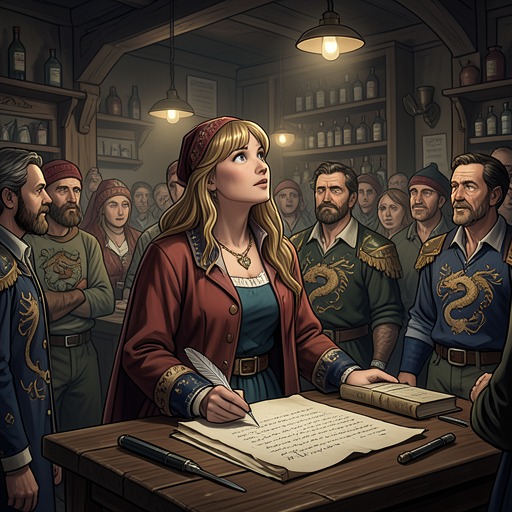
On a slow night, Sylvaine still treats the tavern as though royalty were listening. She bows deeply, straightens her cap, claims the stool at center stage, and begins the familiar tune While the Fisherman’s Away. The performance is bawdy, undemanding for her vocal range, and not her finest work, but it pleases the room even when the room contains almost no audience. Rusty Nail thus becomes the first arena in which she insists that her work deserves recognition despite hunger, obscurity, and indifferent listeners.
Her material circumstances at the tavern remain modest. She wants food in her belly, recognition of her work, and devoted fans, but even reliable meals are not guaranteed. Kingsley prevents her from going truly hungry while struggling financially himself, and he and Brigitta try to include her needs despite the pressure on their purse. Because Rusty Nail has no kitchen, Brigitta cannot simply send out a discreet plate; instead, she makes extra food and presents it as an accident, allowing Sylvaine to accept help without being openly reduced to a dependent.
That kindness contrasts sharply with Sylvaine’s experience at the Red Wyvern Tavern in Birchfield. There, after scraping half-eaten food from dirty plates, she faced an owner who tried to trade food for sex. She fled without planning, carrying only her lute, a few coins from her performance, and her cap pulled down over her ears. Days later she reached Rusty Nail barely able to stand, yet convinced Kingsley to let her sing. Brigitta asked her to sample dishes prepared for the Winter Solstice celebration. Sylvaine later understands that the couple were looking out for her from the beginning, and the tavern’s hospitality becomes the moral opposite of Birchfield’s exploitation.
Rusty Nail also becomes a site where Sylvaine converts uncertainty into performance. When she meets Tomas behind the bar, she immediately recognizes his curiosity about the group of hired swords accompanying her as an invitation to tell a story. Her lute is ready beside Jaromir’s seat, and she sees the moment as her opportunity to prove that continuing the quest is the right path even after Aeron Fowler’s death. The tavern therefore serves as a rehearsal room for the legacy of Aeron Fowler: the place where grief is made speakable through song and where Sylvaine tests whether stories can carry an absent hero forward.
Gossip, Danger, and Social History
Rusty Nail’s reputation is shaped as much by Sylvaine’s inventions as by Kingsley’s actual business. She tells travelers that the proprietor once killed a man with nothing but a spoon and encourages theories that he has killed someone with his bare hands. The rumor has traveled far enough to make a stranger wince when she repeats it. Her talk turns the tavern into a comic legend, giving a small establishment a larger-than-life mythology and making Sylvaine an active publicist for Kingsley’s supposed menace.
The tavern is also a place where social tensions become visible. Sylvaine observes that a dwarven-descended barkeep can enjoy an easy air of camaraderie, whereas an elven barkeep would likely face hostility from rowdy drunkards. She connects this difference to the historical alliance between Hawthok and humans during The Unification, known among elves as The Great Loss. Dwarves who fought in that period were rewarded with land and minor titles in Targgein, while human and dwarven histories preserved an image of themselves as heroes opposing ancient elves portrayed as powerful and malicious.
Against that public history, Rusty Nail offers a small, materially grounded counter-history. Sylvaine’s own elven heritage is endangered by the destruction of elven texts and sacred structures during the raids, leaving spoken word as the means by which her people’s history survives. Her father’s transmission of the ancient elven alphabet and their history is itself an act of rebellion. Within the tavern, then, drink, gossip, labor, and music coexist with the preservation of knowledge that dominant historical narratives have tried to erase.
Memory, Departure, and Return
Rusty Nail becomes emotionally complicated once Sylvaine leaves Hollowden. During a later bath, the practical care attached to her journey recalls the package Kingsley sent when she first departed. She misses the narrow cot in the corner of the small room that Kingsley and Brigitta prepared for her, the poor ale and wine, and the evenings spent badgering Kingsley with ambitious ideas while waiting for Petey to wake and go home. These memories do not mean she wants to surrender the road. She is happy with the quest, adventure, purpose, and Jaromir, and she recognizes that her new companions care for her through mutual understanding rather than pity. Rusty Nail remains home precisely because leaving it has shown her what home gave her.
The tavern is also bound to Jaromir’s earliest memory of Sylvaine. He reveals that he first heard her sing two years earlier at the Red Wyvern in Birchfield, before her flight to Hollowden. On the final night of that period, she played through hunger and fear before singing a lullaby once used by her mother to comfort her. Jaromir remembers her voice as an awakening, and Sylvaine recalls the large, dark-haired man who placed five silvers in her cup, money that allowed her to eat, escape, and live. Rusty Nail is therefore the later refuge that silently contains the consequences of an earlier performance elsewhere: the tavern shelters the bard whose song first connected her to Jaromir before either understood the connection.
Epilogue and Continuing Home
In the epilogue, Sylvaine returns alone to the stage at Rusty Nail and repeats the bow and cap-straightening gesture with which the story began. Kingsley has left her stool in its customary place. She deliberately finds the familiar creak in the floorboard, while the same mismatched chairs sit empty around the tavern. The repetition is not a simple restoration of the past: nostalgia brings pain alongside happiness, and the old room is now experienced by someone whose life has expanded far beyond Hollowden.
Jaromir is her first audience member, watching from a chair in a new leather jerkin whose elven workmanship helped support the rebuilding of Adlanniel’s shop. The ballad of Aeron has traveled with Sylvaine and her companions, and the tavern stands at the threshold of another departure. Before they go farther, however, Sylvaine needs to return to the place that made her survival possible.
Kingsley’s arrival completes the homecoming. His iron keyring announces him before he opens the door, and his astonishment at finding Sylvaine there gives way to an embrace. He says that he and Brigitta thought they would never see her again, revealing that the tavern’s care was never merely commercial; they had come to regard her as family. He pours drinks for Sylvaine and Jaromir and asks to hear everything that happened, restoring the tavern as the place where her travels can be told and received.
Sylvaine’s return is also an act of repayment. She gives Kingsley his share, explaining that she has already paid food and drink suppliers and commissioned carpenters and builders to follow his orders and expand the tavern however he wishes. She calls this only the first part of reciprocating everything he and Brigitta have done for her. The second part is a promise to ensure that they will want for nothing. Her former dependence has become the means by which Rusty Nail can gain security, and charity is transformed into reciprocal care.
The final theatrical gesture is deliberately staged. Sylvaine announces that, as a world-famous bard, she will visit the finest establishments on her circuit while making Rusty Nail her favored stopping place. Cadoc and Neith then enter with a crowd of revelers drawn by the promise of free drinks. The tavern that once struggled for patrons becomes the chosen venue of a celebrated performer and her expanding circle, yet it does not lose its intimate identity. Rusty Nail remains the room of the creaking board, the bad wine, the handmade chairs, and the people who waited for Sylvaine to come back.